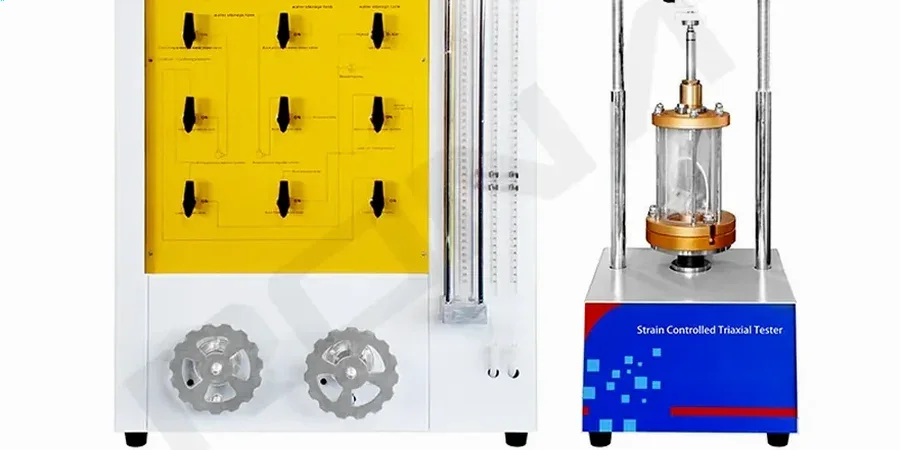
In Quebec City, the behavior of the sensitive Champlain Sea clay deposits defines foundation design from Sainte-Foy to Charlesbourg. The material holds a peak strength that degrades significantly with disturbance, a property that only a well-executed triaxial test can quantify. Contractors working near the St. Lawrence River often encounter layered profiles where silt, clay, and glacial till interact in ways that standard penetration testing cannot resolve. The team here runs consolidated-undrained (CU) and drained (CD) shear tests on undisturbed Shelby tube samples, measuring effective stress parameters that feed directly into bearing capacity and slope stability models. For projects involving deep excavations in the city center, where the marine clay extends 30 meters or more, the triaxial test provides the critical friction angle and cohesion intercept that empirical correlations simply miss. The laboratory follows ASTM D4767 protocols, with back-pressure saturation to achieve Skempton B-values above 0.95 before shearing begins.
A triaxial test on Quebec City's Champlain Sea clay often reveals a sensitivity ratio above 30, meaning the remolded strength is less than 4 percent of the intact peak strength.