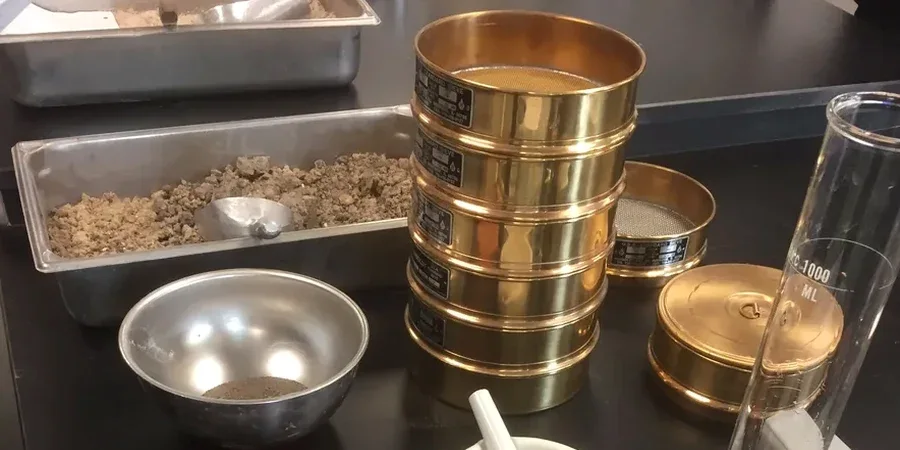
The St. Lawrence Lowlands present a geotechnical puzzle that repeats itself across every borough of Quebec City. Beneath the surface, the Champlain Sea left behind deep deposits of sensitive silty clays whose behavior changes dramatically with moisture content. Winter frost penetrates up to 1.5 meters, spring thaw saturates the ground, and summer construction windows demand fast, reliable soil classification. Atterberg limits testing provides the numerical framework that ties all these seasonal shifts together: the liquid limit, plastic limit, and plasticity index define exactly how a soil will perform when water content fluctuates. Without these three numbers, a foundation design in Sainte-Foy or Charlesbourg is essentially a guess. Our laboratory runs the full suite of consistency tests under CSA and ASTM standards, delivering results that geotechnical engineers across the Quebec City region use to assess bearing capacity, predict settlement, and select appropriate stabilization methods before the first excavator arrives on site. Understanding the fine fraction of a soil profile through grain-size analysis complements the Atterberg limits by separating silt and clay percentages, a critical distinction in the varved sediments common to the region.
In Quebec City's sensitive marine clays, the plasticity index is not just a classification number — it is a direct predictor of long-term settlement behavior under seasonal moisture cycling.