GEOTECHNICAL ENGINEERING
QUEBEC CITY
HomeGeophysicsSeismic tomography (refraction/reflection)

Seismic Tomography (Refraction & Reflection) in Quebec City

Evidence-based design. Reliable delivery.

LEARN MORE

Quebec City sits just 20 km from the Charlevoix Seismic Zone, the most active earthquake region in eastern Canada, where a magnitude 6.2 event struck as recently as 1925. Any deep foundation or slope design here must account for the complex interface between glacial till, marine clay, and the fractured Appalachian bedrock. Seismic tomography, combining both refraction and reflection techniques, provides a continuous subsurface velocity model that standard boreholes simply cannot match. By measuring P-wave and S-wave travel times from surface-generated energy, we map lithological boundaries and identify potential fault zones that could compromise structural integrity. For projects near the St. Lawrence River, where thick Champlain Sea clay masks the rockhead, this method becomes indispensable. We frequently pair it with a targeted CPT test program to calibrate shear wave velocities against cone resistance data, ensuring the geophysical interpretation matches the geotechnical reality of the site.

A single seismic tomography line can delineate the bedrock depression beneath 300 m of Champlain Sea clay, a feature that scattered boreholes routinely miss.
Our service areas

Our approach and scope

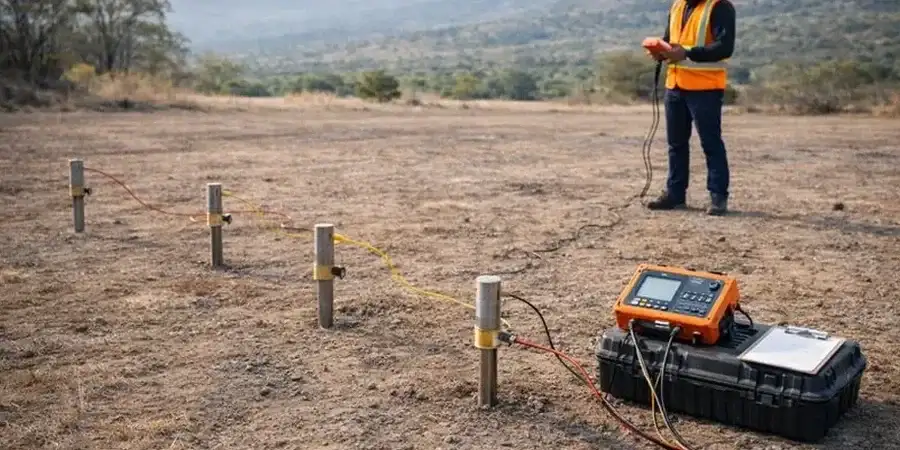
The acquisition setup for a Quebec City survey typically deploys a 48- or 72-channel seismograph connected to a linear array of 4.5 Hz geophones spaced every 2 to 5 meters, depending on the required resolution. The energy source varies with the target depth: a 10-kg sledgehammer on a strike plate suffices for shallow refraction up to 30 m, while a weight-drop or accelerated projectile source is necessary for deeper reflection profiles that must penetrate the compact basal till. Processing follows a deterministic workflow — first-break picking, tomographic inversion via ray-tracing, and finally a velocity model rendered in 2D or 3D. In the Lower Town, where historical fill overlies marine sediments, we adapt the array geometry to avoid cultural noise from traffic and utilities. The resulting P-wave and S-wave sections are then correlated with local SPT drilling logs to anchor the geophysical horizons to known stratigraphic units, producing a ground model that satisfies the requirements of the NBCC 2020 for Site Class determination.
Seismic Tomography (Refraction & Reflection) in Quebec City
Technical reference — Quebec City

Site-specific factors

The urbanization of Quebec City expanded rapidly onto the soft Champlain Sea clay plains throughout the 20th century, a terrain notorious for amplifying ground motion during seismic events and for its susceptibility to lateral spreading. Building on these deposits without a clear image of the underlying bedrock geometry is a gamble — one that seismic tomography effectively eliminates. A reflection survey can reveal buried paleochannels or escarpments that act as seismic wave traps, while refraction tomography quantifies the thickness of the low-velocity zone that governs site period. For developers extending into the steep terrain of Beauport or along the Laurentian foothills, the method also identifies zones of fractured rock where a slope stability assessment would otherwise rely on interpolation between sparse outcrops. The NBCC 2020 explicitly requires a reliable shear wave velocity profile for Site Class E and F evaluations, and seismic tomography delivers this without the invasive cost of a deep cross-hole survey.

Need a geotechnical assessment?

Reply within 24h.

Email: info@geotechnical-engineering.org

Explanatory video

Applicable standards

NBCC 2020 (National Building Code of Canada) — Site Class determination via Vs30, ASTM D5777-18 — Standard Guide for Using the Seismic Refraction Method, CSA A23.3-19 — Design of Concrete Structures (Annex N: Seismic Site Amplification), ASTM D7128-18 — Standard Guide for Using the Seismic-Reflection Method

Reference parameters

ParameterTypical value
MethodRefraction (P-wave, S-wave) + High-resolution Reflection
Max. Investigation DepthUp to 100 m (refraction) / 500 m (reflection)
Geophone Array48–72 channels, 4.5 Hz vertical component, 2–5 m spacing
Energy SourceSledgehammer, weight-drop, or accelerated projectile (Betsy Seisgun)
Output ParametersVp, Vs, Poisson's ratio, bedrock topography, rippability
Data FormatSEG-2 / SEG-Y, compatible with GIS and CAD platforms
Applicable StandardASTM D5777-18, CSA A23.3 Annex N, NBCC 2020 Site Class

Quick answers

What is the typical cost of a seismic tomography survey in Quebec City?

A standard 2D refraction line of 115 m length typically falls between CA$3,550 and CA$5,200, while a longer reflection profile or a combined refraction-reflection survey with deeper penetration ranges from CA$5,800 to CA$7,560, depending on the number of shot points, source type, and site accessibility within the Quebec City region.

Can seismic tomography work in winter conditions on a frozen Quebec City site?

Yes, winter surveys are feasible and sometimes preferable on frozen ground that provides stable access over soft clay. The frozen crust does not significantly attenuate the seismic signal, though we use a larger energy source to compensate for the high-velocity frozen layer at the surface and ensure adequate penetration to the target depth.

How does the presence of Champlain Sea clay affect the survey data?

The thick Champlain Sea clay, often exceeding 40 m in the St. Charles River valley, acts as a low-velocity layer that absorbs high-frequency energy. We counter this by extending the geophone spread, using lower-frequency geophones (4.5 Hz), and applying solid static corrections to ensure the bedrock reflection is clearly imaged beneath the clay.

What deliverables do I receive after the survey?

You receive a comprehensive report including a 2D P-wave and S-wave velocity section, interpreted bedrock surface and overburden stratigraphy, a Vs30 calculation for NBCC Site Class determination, and the raw SEG-2 field files. The interpretation includes a discussion of velocity anomalies, potential fault zones, and material rippability.

Location and service area

We serve projects in Quebec City and surrounding areas.

View larger map