GEOTECHNICAL ENGINEERING
QUEBEC CITY
HomeInvestigationCPT (Cone Penetration Test)

CPT Testing for Quebec City’s Champlain Sea Clay and Glacial Till

Evidence-based design. Reliable delivery.

LEARN MORE

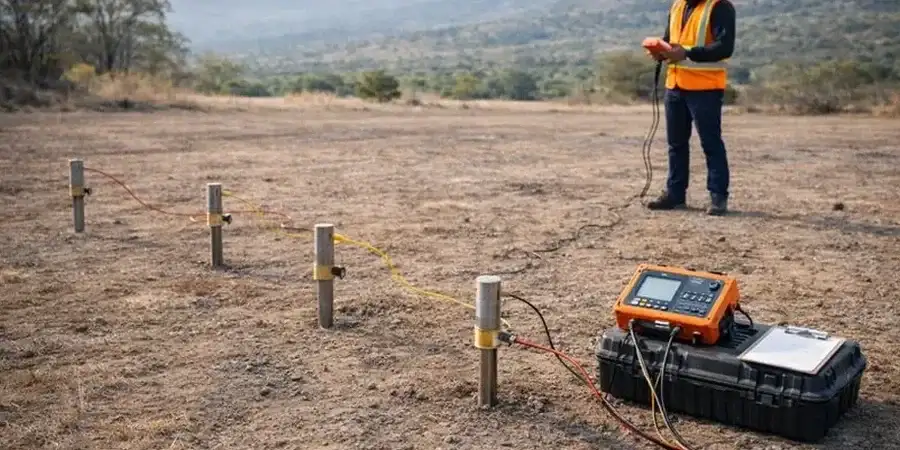
The St. Lawrence River carves a deep channel past the cliffs of Quebec City, but it is what lies hidden beneath the surface that dictates every foundation decision here. Post-glacial Champlain Sea deposits dominate the lowlands—soft, sensitive clays that lose strength when disturbed. Up on the Promontory of Quebec, shale and sandstone bedrock sits beneath a thin, erratic mantle of dense glacial till. Standard penetration testing often struggles to capture the fine layering in these formations. We deploy electric friction-cone CPT rigs capable of pushing through stiff crusts and measuring pore pressure in real time, which is essential for identifying thin silt seams that control slope stability along the Côte de Beaupré. For projects near the Old Port, where historical fill overlies marine clay, the continuous data stream from a CPT test eliminates the blind spots that traditional boreholes leave behind.

In Quebec City, a CPT pore pressure spike isn't noise—it's often the only warning of a thin silt seam in the Champlain clay that will double the consolidation settlement timeline.
Our service areas

Our approach and scope

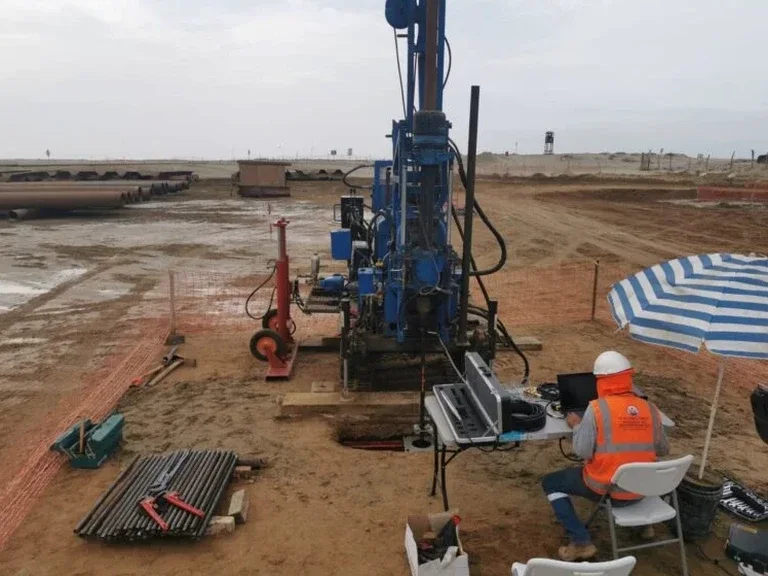
A defining feature of the Quebec City region is the presence of the Champlain Sea clay, which can exhibit sensitivities exceeding 30—meaning it turns to slurry when remolded. This clay blanket, often 20 to 40 meters thick in the Saint-Charles River valley, is interbedded with silty lenses that act as drainage paths and accelerate consolidation. Our CPT soundings here focus on corrected cone resistance (qt) and pore pressure ratio (Bq) to classify soil behavior type. The Bq value is particularly telling: a spike in pore pressure during penetration signals a silt seam that could cause a time-dependent settlement problem under a mat foundation. On the higher terraces of Sainte-Foy, we encounter dense till with tip resistances frequently surpassing 25 MPa. The rig must be solid—a 20-ton truck-mounted unit with hydraulic thrust capable of penetrating refusal at the bedrock interface. This sharp contrast between soft clay and hard till, often within the same single-family lot, is why we push the cone as close to refusal as the stratigraphy allows.
CPT Testing for Quebec City’s Champlain Sea Clay and Glacial Till
Technical reference — Quebec City

Site-specific factors

The CPT rig we bring to Quebec City is a heavy, 20-tonne truck with a hydraulic ram mounted directly over the rear axle. It is not a delicate probe; it drives a steel cone at a constant 2 cm per second into whatever lies below. The risk of skipping this investigation is concentrated in the Champlain clay: without a dissipation test to measure the coefficient of consolidation, the designer assumes a drainage path that may not exist. We have seen projects on the Beauport flats where the settlement rate was underpredicted by a factor of three because a single silt seam was missed by a spoon sample. In the winter months between December and March, frozen ground up to 1.8 meters deep poses an additional challenge. We pre-drill through the frost layer to avoid damaging the cone sleeve, and we use glycerin as a saturation fluid to prevent freezing in the transducer cavity. A damaged cone in frozen soil generates erratic friction ratios that can misclassify a stiff clay as a sand, leading to an unsafe bearing capacity assumption.

Need a geotechnical assessment?

Reply within 24h.

Email: info@geotechnical-engineering.org

Applicable standards

ASTM D5778-20 (Standard Test Method for Electronic Friction Cone and Piezocone Penetration Testing of Soils), CSA A23.3 (Design of Concrete Structures, referencing geotechnical parameters derived from CPT), NBCC 2015, Division B, Part 4 (Seismic design requirements, with site class determination via CPT shear wave velocity correlation), Robertson & Cabal (2015) Soil Behavior Type classification system

Reference parameters

ParameterTypical value
Maximum Push Capacity20 metric tons (200 kN)
Cone TypePiezocone (CPTu), 10 cm² area
MeasurementsTip resistance (qc), sleeve friction (fs), pore pressure (u2)
Typical Depth in ClaysUp to 35 meters in Champlain Sea deposits
Data IntervalContinuous at 2 cm vertical spacing
Friction Ratio CalculationRf = (fs/qc) x 100, soil behavior type per Robertson (1990)
Saturation FluidGlycerin for sub-zero spring operation

Quick answers

How much does a CPT test cost for a typical residential lot in Quebec City?

For a single-family residential lot in the Quebec City area, a CPT sounding typically falls between CA$220 and CA$320 per location, depending on total depth and winter pre-drilling requirements. Multiple soundings on the same site reduce the per-point cost due to mobilization efficiency.

Why is CPT preferred over SPT in Champlain Sea clay?

Champlain Sea clay is highly sensitive to disturbance. An SPT sampler driven by a hammer remolds the clay, yielding unreliable blow counts. The CPT pushes a cone at a constant rate, measuring undisturbed pore pressure and tip resistance, which reveals thin silt seams and the true sensitivity of the deposit.

Can the CPT reach bedrock on the Quebec City promontory?

On the promontory, where till overlies shale, we typically achieve refusal at the bedrock interface, which often occurs at penetration resistances above 50 MPa. The 20-tonne rig can push through dense till but will stop at competent rock. The depth to refusal gives a precise bedrock surface elevation for pile design.

Do you need to pre-drill the CPT hole in winter?

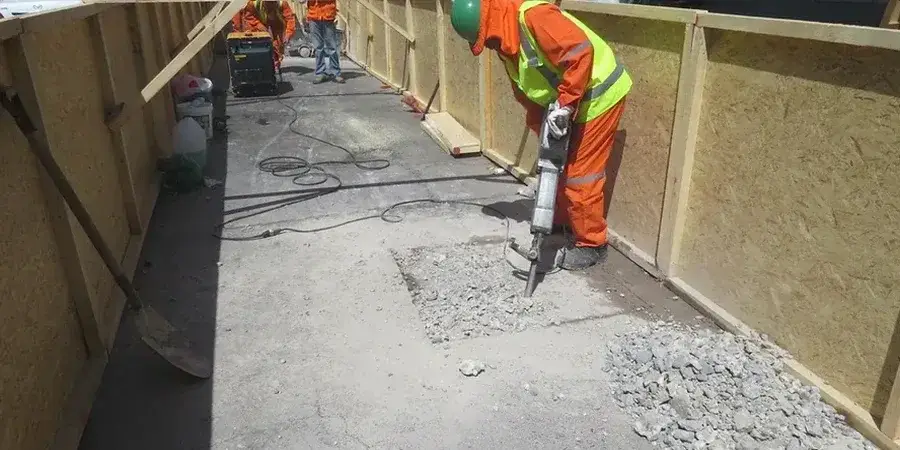
Yes, in Quebec City, the frost depth regularly exceeds 1.5 meters from December through March. We pre-drill through the frozen crust using a hollow-stem auger to protect the cone sleeve and ensure pore pressure measurements are not compromised by ice blockage.

Location and service area

We serve projects in Quebec City and surrounding areas.

View larger map