GEOTECHNICAL ENGINEERING
QUEBEC CITY
HomeInvestigationExploratory test pit

Exploratory Test Pit Services in Quebec City

Evidence-based design. Reliable delivery.

LEARN MORE

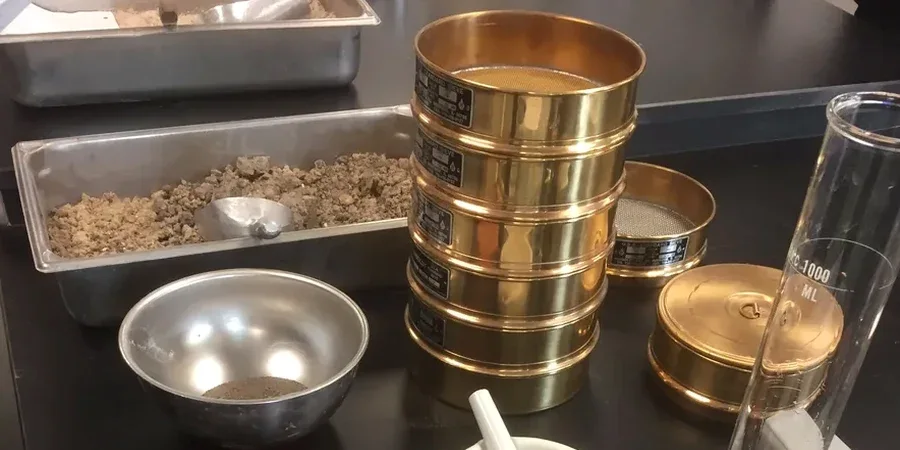
The freeze-thaw cycles in Quebec City demand more than a standard desk study before you break ground. With average winter lows dipping to -18°C and frost penetration often exceeding 1.8 meters in the Saint Lawrence Lowlands, the upper soil profile can hide ice lenses, disturbed Champlain Sea clays, and boulder-strewn till that simply won't appear on a borehole log. Our exploratory test pit approach opens a window directly into these layers, allowing our field team to log stratigraphy by eye, collect undisturbed block samples from the critical frost zone, and flag any organic infill that would compromise a footing. We work from Beauport to Sainte-Foy, coordinating with plate load tests when the client needs a direct bearing capacity correlation right at the excavation bench, and we lean on grain size analysis to confirm the fines content in those silty lenses so common near the Saint-Charles River.

A single exploratory test pit at the right location reveals more about frost susceptibility and rockhead geometry than a dozen split-spoon samples taken blind.
Our service areas

Our approach and scope

What we observe repeatedly across the promontory and the lower town is that the contact between the glacial till and the underlying fractured shale of the Utica Group can be extremely irregular—sometimes varying by half a meter within a single building footprint. An exploratory test pit lets us walk that contact, measure the dip of the rockhead, and photograph the slickensided surfaces that signal past slope movement in the Cap Diamant area. We log every pit following the Canadian Foundation Engineering Manual guidelines, capturing moisture content at 30 cm intervals, recording cobble percentage by visual estimate, and noting groundwater seepage rates where the till transitions to a more pervious gravel lens. For projects near the cliffs of the Upper Town, this direct observation feeds directly into a slope stability assessment, giving the geotechnical engineer real geometry instead of an interpolated cross-section.
Exploratory Test Pit Services in Quebec City
Technical reference — Quebec City

Site-specific factors

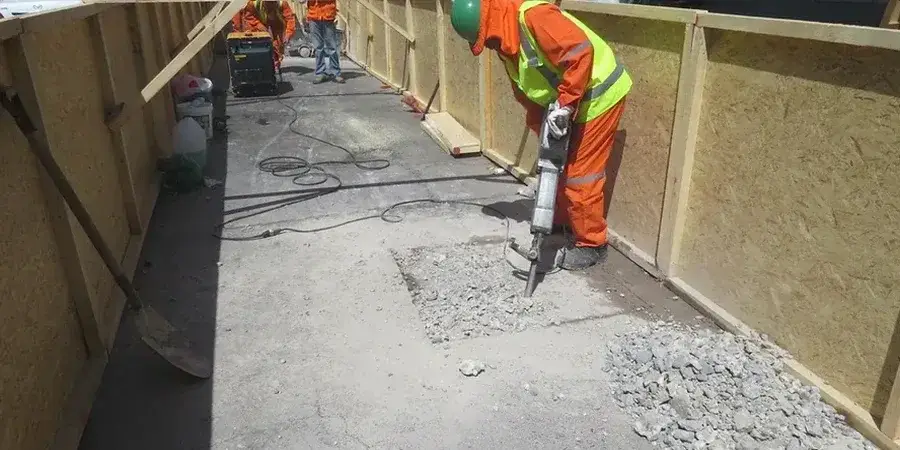
A Cat 320 excavator fitted with a 60 cm cleanout bucket works well in the dense till north of Boulevard Laurier, but get into the sensitive marine clays near the Old Port and that same bucket can smear the sidewalls, hiding thin sand partings that control drainage. Our site supervisor watches the bucket teeth marks in real time—if the clay starts coming up in polished sheets instead of chunks, we stop and switch to hand-trimming for the logged face. The real risk in Quebec City is hitting an unmarked backfill pocket from the 19th century, especially anywhere below the fortification walls. Old timber cribbing, buried foundations, and coal ash layers are common in the Vieux-Québec sector, and a test pit without a spotter who knows the historical maps can unknowingly log a cultural layer as natural ground, leading to a foundation design that doesn't account for differential settlement over the buried debris.

Need a geotechnical assessment?

Reply within 24h.

Email: info@geotechnical-engineering.org

Applicable standards

NBCC 2020 – Division B, Part 4 (structural design and frost protection), CSA A23.3:19 – Design of concrete structures (concrete exposed to sulfate in Champlain Sea deposits), ASTM D2487-17 – Unified Soil Classification System (visual-manual procedure for pit logging), ASTM D2488-17 – Standard practice for description and identification of soils (visual-manual procedure)

Reference parameters

ParameterTypical value
Typical excavation depth2.5 to 4.5 m (shored as required)
Logging standardCanadian Foundation Engineering Manual, 4th Ed.
Sampling methodBlock samples (Shelby tubes in clay layers)
In-situ field testsHand vane shear, pocket penetrometer, DCP on pit floor
Photographic recordFull-depth digital log with scale and north arrow
Frost-depth profilingSeasonal monitoring pits, October through April
Backfill compaction checkNuclear density gauge or sand cone upon restoration

Quick answers

What is the typical cost of an exploratory test pit in Quebec City?

For a single exploratory test pit excavated to 3-4 metres depth with full logging, photography, and a technical report, the cost typically falls between CA$780 and CA$1,220. The final figure depends on access conditions, whether shoring is required, and the number of samples collected for lab testing.

How deep can you go with an exploratory test pit in the till around Quebec City?

In the unweathered till that dominates much of the region we can typically reach 4 to 4.5 metres with a standard excavator before hitting practical limits. If the water table is high—common in the lower Saint-Charles River plain—we may stop shallower or install a sump pump. For depths beyond 5 metres, a borehole becomes more practical and we often recommend combining a test pit with an SPT drilling program.

What safety measures do you follow when excavating test pits in urban Quebec City?

Every pit deeper than 1.2 metres is shored, benched, or sloped according to the Quebec CNESST safety code. In the narrow streets of Vieux-Québec we use modular trench boxes and continuous gas monitoring because of the risk of encountering old service lines or decaying organic fill. Traffic control plans are submitted to the city when the pit encroaches on the public right-of-way.

Location and service area

We serve projects in Quebec City and surrounding areas.

View larger map